Showing posts with label garden. Show all posts

Thursday, May 2, 2013

Strawberry Transplants: Not for the Faint of Heart


I love having my kids help in the garden. This is the story of what can go wrong --but it has a happy ending.
 
We have a strawberry patch that needs to go. It is overrun by weeds and doesn't get much sun like it did a few years ago. I've also heard that strawberry patches should be moved every so often for a better strawberry yield.
Last fall I transplanted many plants to the unused sections of our seldom-used playground area. Amazingly, they survived the winter.
 
Then came the sad spring day when I was touring a college with my oldest while my husband and boys weeded the gardens at home. My husband texted, "Were the boys *supposed* to remove all the strawberries from the playground?"
 
I wanted to drive home immediately.
 
Despite efforts to replant the weeded plants, most died.
 
New project for me: transplant even more strawberries.
New project for the boys: build a fence from sticks.
 
 
Now it is clear to see that the corners of the playground are GARDENS. The little fence should keep out children, even if it doesn't work on cats.


Wednesday, March 21, 2012

Fox-Proof Fence


This is the tale of our Fox-Proof fencing. And of how we learn as we go.

Before we dreamed of chickens, we had a small garden. It is long since gone (there is now a shed on the spot where our first vegetable garden once was), but it taught us two things about fencing: if the fence isn't tall, the deer bounce right over it; and if the fence isn't buried, the bunnies go right under it.

So, the next fence we made was buried several inches.


Then along came the chickens.  We built three large garden plots.  The chickens spend a year in each plot, and we rotate both crops and chickens so that there is a nice cycle of tilling, fertilizing, and bug munching.  When we first built the plots, we researched fencing and learned that a fox-proof fence should include a buried section that prevents a fox from digging under the fence.


We thought: chickens=chicken wire.
But only four years later, that chicken wire had rusted so badly, that there were gaps in the fencing that bunnies, foxes, and even chickens could manage.
This weekend I added a new, galvanized hardware cloth over top of the chicken wire. (It would have been too difficult to remove the chicken wire since it is half buried.)


Near the gate, I left gaps because transporting the coop through the gate door will require us to fold down the hardware cloth.


The most difficult stretch to manage was the side of the fence near the trees. In order to install the hardware cloth, a foot of earth needed to be moved, the 'cloth' needed to be rolled out and folded into an L shape, the floor was secured with landscape pins, and then the earth was added back on top of it, covered by a layer of mulch.  Finally, my boys and I used galvanized 18 gauge wire to tie the hardware cloth to the existing fence.
I did not use the camera during that long ordeal, so for the shot below I dug away a bit of earth to show how the hardware cloth folds out into the mulched area about 12 inches.


We know that foxes can climb, but we did not add the curved section at the top of each fence to prevent anything from climbing over.  We did have aviary netting secured over all our garden plots at one point, but a freaky October snow destroyed all of that and we haven't bothered replacing it.
I'm hoping foxes don't read this blog.

Saturday, July 30, 2011

Garden Mid-Season Update


We are right in the middle of our growing season, so this is a good time to look at how things are growing. Often, this time of year, we are so busy picking tomatoes and figuring out new ways to use zucchini that we don't get a chance to take any pictures of the garden.  I had to force myself to get the camera outside this morning.
Above, you see one sad rosemary plant (I don't hold much hope for the winter for this guy), some fantastic sage on the ground and a fragrant pineapple sage in the center.  I do love sage.

Below is another shot of the same herb garden, in which you can see some fennel, chocolate mint, and peeks of very crowded oregano.  I transplanted some oregano to another herb garden in the spring because the oregano is clearly losing this fight.(see their spring pics)


The cone flowers (echinacea) are at the end of their glory; the bees and butterflies have stopped visiting them and have moved on to the mint and Russian sage.  We will leave these as a winter treat for the birds.


Below is the Italian garden.  The tomatoes, basil, eggplants, peppers, cucumbers, and flowers are all doing well. I've mulched over the new asparagus planted this spring just outside the fencing.


It is getting difficult to walk in the squash garden, below.  My new butterfly weed just outside the door has finally stopped being food for the wildlife, so I removed the cage my sons made for it.  The purple cabbage is grown mostly for the chickens, which means I don't need to worry about any bugs eating it (extra treats for the chickens).


I do love little pathways...
This one leads to the newly weeded and mulched strawberry patch.


The cucumber plants are doing really well.  I'm hoping to try making pickles this summer.


Searching for the cucumbers is fun.  Equally fun is the search for pumpkins in the mass of vines below.  If you look carefully, you'll see a large green one hiding in the leaves.  We've gotten zucchini, spaghetti squash, patty pans, and pumpkins so far this year.


Not everything is going as planned in our garden.  The blackberries are looking less-than-lovely this year.  I'm thinking that the chickens might be getting more berries than normal.


The struggle to grow pole beans AND limit the Mexican bean beetle population by planting in the chicken coop is a work-in-progress.  The first problem we found is that the chickens kept getting into the bean area of the coop, trapped in there with nothing to do except eat bean plants. I limited the area by just fencing two of the best plants.  The second problem is that the chickens don't seem interested in eating the bean beetles! Figures.

We never realized how the wind patterns around our property would affect what we grow, but now that we've got six fruit trees on the top of our hill, we realize that there is somewhat of a wind tunnel going through there.  We've staked one of the peach trees to help keep it upright during the gusts.

The blueberries in the above picture are finished for the season, so they've been weeded and mulched.  At this point in the year, we are turning our attention to harvesting vegetables, bracing ourselves for the big apple harvest in September.

Monday, May 30, 2011

Harvest Shot

The strawberries are in!
Just when I thought it would be a bad year for strawberries, I come back from a weekend holiday and find that the slugs, the birds, and the fox did not eat all of the fruit after all.

Sunday, May 15, 2011

Chickens as Gardeners

Besides laying beautiful eggs each day for us, our chickens are fantastic gardeners.  They till one garden plot each season for us (they follow the squash garden and the Italian garden follows them), turning the soil, eating all the weeds and spent plants, and removing bugs who have overwintered in the soil.  This year, they've also agreed to monitor the pole beans for us.

Pole beans are a favorite here.  They are easy to grow, give a large yield without too much effort, and the kids enjoy the growing plants and the finished product.  We were surprised last year to find, for the first time, Mexican bean beetles on our plants.  What look like yellowy-orange lady bugs eat the leaves of the pole bean plant, thus depriving the plant of photosynthesis.  We still got beans, but much less than normal, and the plants looked really ugly with their decimated leaves.
So, what's a gardener to do?

 That's right:  bring in the chickens!

Rather than rotating the pole bean crop to a new garden with the squash and cabbage, we planted them in the same spot as last year.  Normally, that would be an invitation to the overwintered bugs for a repeat performance, but this year, the chickens are in that garden.  I installed rabbit fencing along one wall of their yard, with bamboo stakes for support (and for the pole beans to climb).  The pole beans are planted in between the rabbit fencing and the fenced wall of the yard.  So far, the chickens have not dug under the fencing. I'm *hoping* that by the time they undermine the rabbit fencing, the pole beans will be well-established.  Once the plants are tall enough, the chickens will do little damage to them.
As the plants grow, any Mexican bean beetles that emerge will become chicken food (if they cooperate with my grand scheme).  Any that appear on the leaves can be easily knocked off for the chickens...integrated pest management and organic gardening.  It will be a win/win...if it works.

*UPDATE*6/5/11
This morning I found Indigo trapped in the pole bean part of the chicken yard.  We were not in the garden at all yesterday, so we didn't notice her in there.  She seemingly dug her way under the rabbit fencing and must have spent the night in there.  Needless to say, the pole beans are all broken and/or eaten.  I planted some more today.

Rosemary Contenders

Every year is a new attempt at getting a rosemary plant to overwinter.  None of our locations last summer worked.  Not being gardeners who give up easily, we've planted some new rosemary.  The first plant pictured here gets my highest vote of confidence.  It is near the house, in an alcove to protect it from high winds, and will get full sun all morning.
 Below is a shot of the plant for which I have the least confidence...seeing how the plant in this location died last year AND the year before.  It is just such a nice location, convenient to the kitchen and near lots of other herbs (who all manage to overwinter--go figure!) so I keep trying.  The big disadvantage to this spot is that the plow tends to dump 8' piles of snow here every winter, which may be too much for a rosemary plant to tolerate.  You think?
 Here we see another failed location, but for some of the same reasons listed above, we're going to try again.  This little plant will get lots of sun, is near other herbs (who also do quite well), and the guy we planted here last year *almost* overwintered.  It had a tiny section of green on it this spring, unlike the other rosemary plants that were shriveled and brown. See below that I've surrounded this newcomer with rocks to help it retain some heat.  Do I think that will work?  No, not really;  but it looks nice and helps ease my conscience.  The sage behind it is gorgeous, by the way.  I'm hoping it will be a good role model for the new rosemary plant.
I'm very excited about this last location.  Close to the wall of our outdoor grill, this plant will benefit from the warmth that the stones collect all day in the sun.  It will also be partially protected from the elements all winter.  I deem this plant "second most likely to succeed".

Saturday, April 30, 2011

Ten Things I Love About Sping

1.  The strawberries are getting ready to start our first harvest of the season.

2.  The mint and oregano are still behaving enough that I can still see my little bear statue.  By the end of summer, they'll be duking it out in this corner of the shed garden. (See the mint in the front and oregano in the back.)

3.  Not everything died over the winter.  That alone is reason to celebrate. (See the fennel and a rouge holly.)

4.  Lily of the Valley is starting to emerge.  I was told when I planted it that there is some lore surrounding the effect Lily of the Valley may have on the gardener's heart, but I'm glad to say that several years later my heart is still beating. That is just another reason to be glad.
5.  Apple blossoms! And this year, with our new hive, it is fun to watch honeybees on the blossoms.

6.  The tulips weren't eaten!  This is only the second time in eleven years that we've gotten to enjoy tulips.  The tulips usually are eaten as soon as the leaves spring up.  I'd like to think our fantastic abstract art scared away the culprit this spring.

7.  Cherry blossoms fall like snow in our front yard each spring. The children sometimes dance around in them.  The chickens eat them.  It is all very enchanting.

8.  The Bleeding Heart is taking over.  Maybe soon it will camouflage the hose that I can't seem to correctly coil.

9.  These irises are refreshingly low-maintenance -- my kind of plant.

10.  I don't mind dandelions. I know most people hate these little guys, but they make me happy.  That little Lemon Balm growing near the center is another story (Argh!! It's everywhere!), but the dandelions are yellow, free, apparently nutritious, and good for the honeybees. I hear they make good wine, too (we'll have to try that).  They are endless fun for children. They are a sure sign that spring is here.

Wednesday, April 20, 2011

Installing Honeybees

As soon as my cat became quite used to her new play area, we've ruined all her fun by installing honeybees.
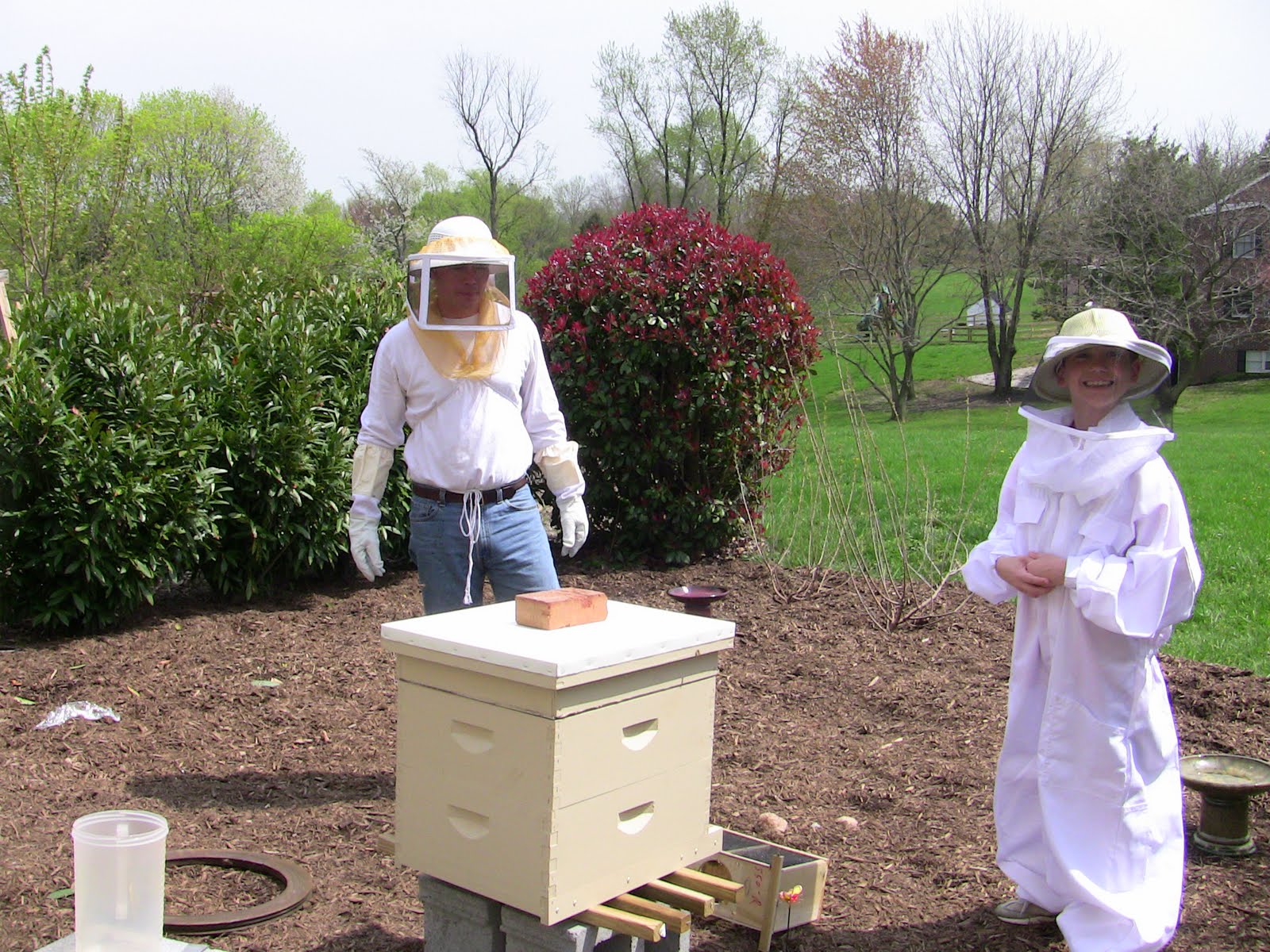
The honeybees arrived in a package of about ten thousand.  The queen was inside a smaller cage in the center of the cage you see below.

 We sprayed the package several times with sugar water to make the honeybees happy and full.  It also attracted a variety of neighborhood bees and other winged insects into our garage.  Note to self: don't spray tons of sugar water in the garage next time.
Brave husband and brave son (in baggy beekeeper suit!) opened the package and literally dumped the bees into the hive.  (Little brother needed to hang back because we don't yet own a veil for him.)   They made an opening in the tiny queen cage and wedged the queen cage into the hive where the other bees will hopefully find her and rescue her from her little cage by chewing through the candy that blocks her exit.  Finally, a top-feeder full of more sugar water was placed on top of the hive and the lid was sealed with a brick to stop the high winds from wrecking everything.

Now we just need to wait and see if the honeybees like their new home.

Busy as Bees

We've been busy this spring! New this year is an asparagus patch.
It won't yield any asparagus this year or next, so it is more of a long-term investment.
Speaking of long-term investments, we are also starting an adventure with honeybees. We won't get any honey until at least next year.
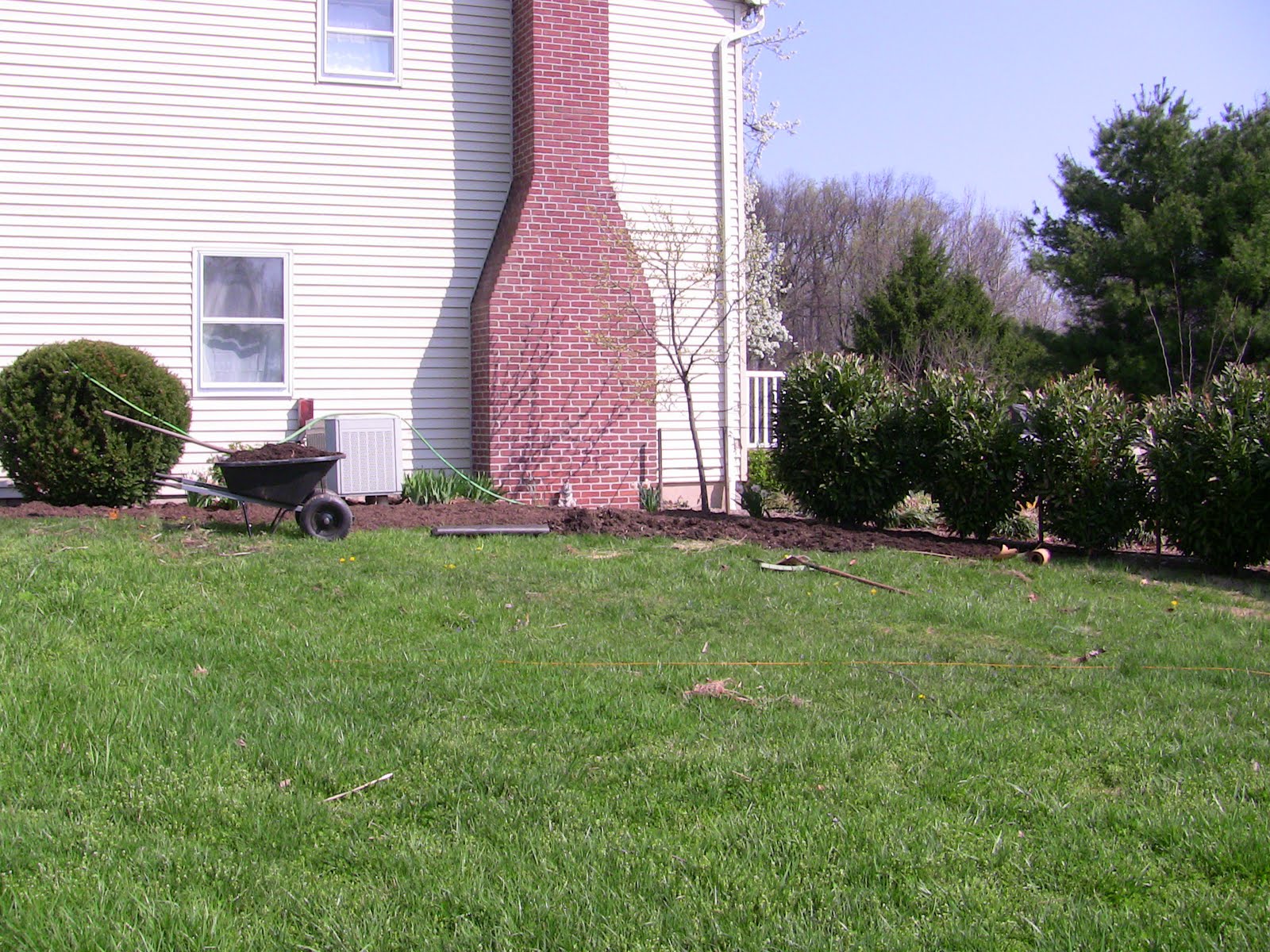
After spending a weekend digging the asparagus pits, I spent several days transforming a huge patch of grass (above)
into a bee yard. (below)


Saturday, September 18, 2010

Seashell Sidewalks

Got seashells?  My sister gave us a bag full of shells from her recent vacation.  The boys had a great time turning these shells into sidewalks for fairies and dinosaurs in one of our herb gardens. Above, you can see a dino 'back in thyme'.
We've done similar seashell gardens before, so we know to expect wild birds to completely wreck it by winter.  The birds pick up the shells, hoping they might still house edible treats.  It is OK.  It will be fun in the spring to find random seashells scattered in the mulch, and the shells are good for the soil.
Most importantly is that this project kept both boys occupied for a few hours. : )

Thursday, September 9, 2010